True confidence and executive presence come from opening your body, releasing protective patterns, and choosing to take up space authentically, not by being louder, but by being more fully yourself.
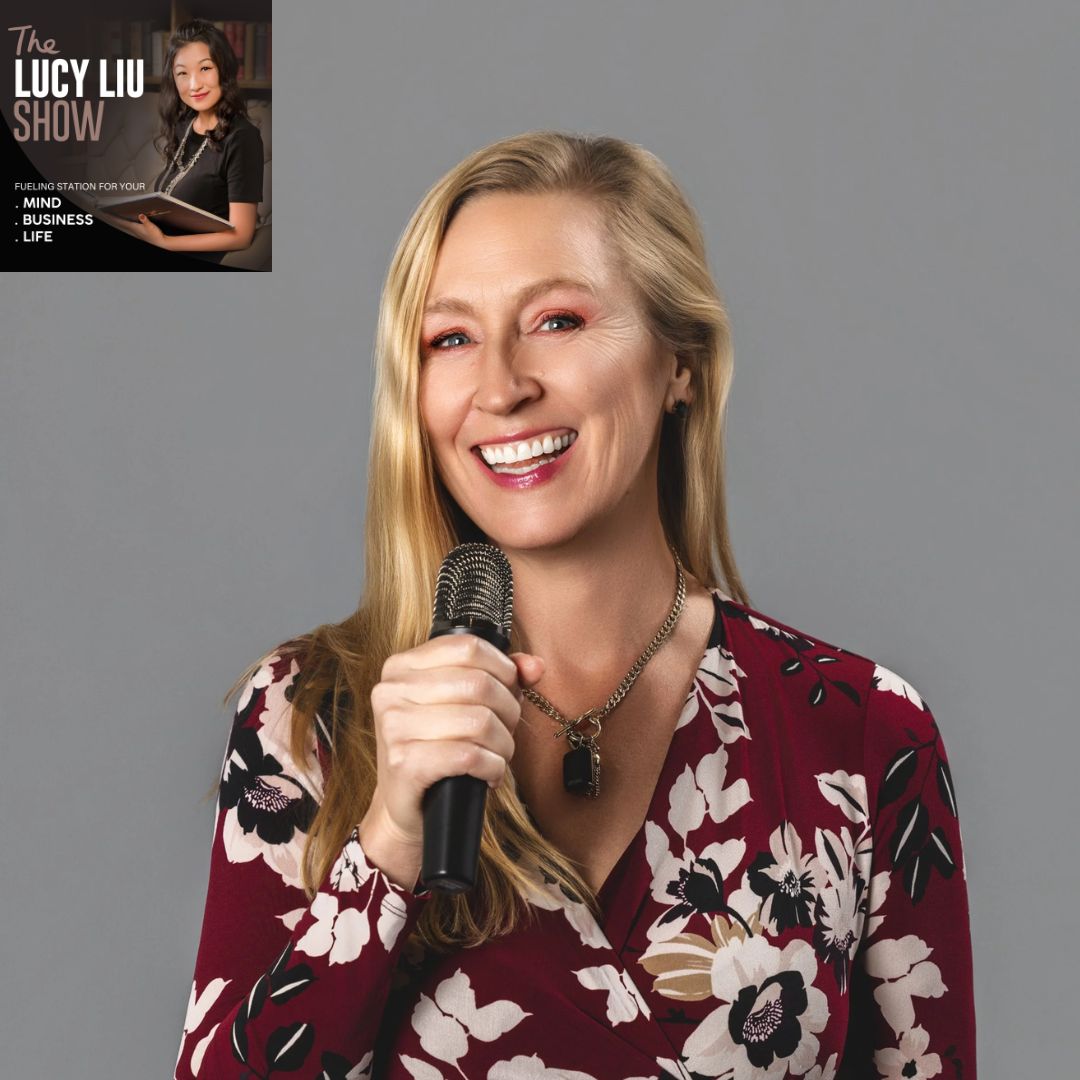
Guest Sharon Jakubecy is a Keynote Speaker on Confidently Take Up Space: Empower Your Executive Presence and public speaking coach
Key takeaways:
- Many women unconsciously shrink through body language, even when they are successful and capable.
- Executive presence is not about force or masculinity, it’s about openness, emotional availability, and grounded energy.
- Confidence is felt through embodiment (breath, posture, voice), not just mindset.
- Small physical shifts: like relaxing the shoulders and extending the exhale,can instantly calm nerves and increase presence.
- Healing, self-awareness, and practicing taking up space gradually are essential to showing up fully and authentically.
LISTEN TO THE PODCAST
WATCH THE EPISODE
Connect with Lucy:
Instagram: https://www.instagram.com/mslucyliu
Facebook: https://www.facebook.com/mslucyliu
Twitter: https://www.twitter.com/mslucyliu
LinkedIn: https://www.linkedin.com/in/mslucyliu
TikTok: https://www.tiktok.com/@mslucyliu
YouTube: https://youtube.com/@mslucyliu
Website: https://www.lucyliucoaching.com
Podcast: https://www.lucyliucoaching.com/podcast
Wanna double your confidence in 30 seconds?
Get the ultimate secret here:
FULL EPISODE TRANSCRIPT
Hello, hello, beautiful souls. Welcome back to another episode on the Lucy Liu show. And I’m super excited to have my special guest today, my friend Sharon Jakubecy.
Sharon is a keynote speaker, executive presence coach, public speaking coach, and we are part of this amazing community together. And we love each other, basically. So yeah, she needs to be here.
So good to be here with you.
Awesome. Okay, so Sharon has a very similar talk than what I usually do, because we just love inspiring, empowering other women. We love to talk about this.
And that is to take up space to not shrink yourself and show up with confidence. So Sharon, for you, when you say confidently take up space, what does it look like for you?
Yeah, so so many women have learned to sort of like, make themselves more palatable to like shrink, literally, even if they are speaking in front of other people, they’ll do something, they’ll literally shrink their bodies and like pull their heart back, push their head forward to seem more approachable. And I’m an embodiment coach, I help women release the armor of tension so that they’re physically open, which allows them to be emotionally open. And it also allows their voice to be open.
So their their voice resonates with their audience.
I think this is really essential to talk about because we think, Oh, well, I’m a successful woman. But unfortunately, many successful women still feel like shrinking themselves, whether that’s in meetings, whether that’s in relationships, because we see this so much, right, Sharon?
Yeah.
And I don’t even think it’s a conscious choice, especially if someone if a woman is like crossing her legs, crossing her arms and leaning in like this. I don’t think it’s a conscious choice like, Oh, I’m going to shrink myself to to make someone else feel comfortable. I think it’s very unconscious.
And so the opening of the body language where you’re uncrossing your legs, uncrossing your arms and, and actually able to breathe while taking space can sometimes feel so vulnerable for women.
So what was a moment in your own life when you realized you were playing small and what shifted for you?
Well, there’s a couple different chapters. But I would say in the beginning, I was in my 20s, I was a dancer and choreographer, but I had excruciating hip and back pain. And as a young woman, I had also like developed early.
So I, you know, carried myself even though I was a dancer and a choreographer in the rest of my life, I was carrying myself and shrinking myself to sort of hide and not be vulnerable in terms of my womanhood and my femininity. And I was literally trying to get out of pain when I needed to take up space, because it was painful to be in that in that shape. And then more recently, in 2020, I went through shocking and traumatizing divorce.
And at the same time, my business almost completely disappeared with COVID. And I had to like go to my mom’s I was like, curled up in a little ball, like, you know, mascara running down my face. And I realized like, I need to use all the tools I give my client so that I can come back out into the world heal from the pain of loss and grief, but come back out into the world and take up space and use my voice.
Beautifully said. Now you coach on executive presence. And we all want that.
But let’s define it. How do you define it in simple terms?
First, I want to say what I don’t define it as I don’t define executive presence as some sort of masculine armor that is one shape for everyone. Executive presence for women is when they can let go of all of this armoring, this protecting of oneself, protecting the heart, pulling back in the body when they can let go of all of that protection, literally their heart opens their shoulders drop. So that openness physically, and the openness emotionally, the emotion, the openness of the heart is what I define executive presence for for a woman.
It’s open, it looks confident, but it’s not an external fake shape. It’s literally the woman opening to her full size. And then from there, her message just pours from her body.
I love that answer. Because when we hear the word executive, it sounds so masculine, it sounds so aggressive, right? But I think, as you mentioned, it’s the very subtle behavior.
It’s actually the internal shift that instantly signals executive presence. What are some other habits that you think unintentionally undermine someone’s presence in the room?
Well, one is also the other, the opposite of like shrinking is trying to stand up straight, and like pulling the shoulder blades back, lifting the chin. That is so it’s false, it doesn’t fit on a female body. Those habits to try to force uprightness really interfere with one’s emotional availability, one’s openness to their teams, it definitely interferes with their vocal quality, their vocal tone.
And that’s another thing that comes with this executive presence is that grounded, resonant vocal tone and lose that as soon as you try to like force and put on that masculine shape.
Yeah, so true. But what about for someone who is naturally more quiet and introverted? And I know you’ve heard my talk.
So you know, already that I talk about confidence is not about being loud. It’s not about decibels. I usually I mean, I’m usually very quiet and introverted in rooms.
But Sharon, from what you see, even when I’m quiet, do you feel that confidence presence?
Yeah, you don’t have to be loud to be confident there. There really is. And I also come from the world of theater and performance, there can be so much said when someone like yourself is grounded in their body and open and not saying anything, there’s an openness and a glimmer in their eye.
And even like an openness across the mouth, whether or not protecting themselves with a tight jaw that says so much to your teams to your audiences, you don’t have to be loud. And in fact, when I work with my clients on vocal tone, I don’t talk about volume, I talk about resonance and vibration, your voice is literally vibrating in your body. And when you don’t shrink yourself, that vibration of your voice just fills the room.
And that’s actually what captures people’s hearts and minds with your message.
Yes, absolutely. I agree completely. But what is your advice for someone who wants to speak up more in a room full of strong personalities with without feeling intimidated?
Yeah, I would say even before someone like that, before you walk into the room, and maybe you’re in your office, or you’re in your car, and you actually let some breath out of your mouth. So I teach this all the time. It’s called a whisper dot sounds like this.
It’s the most open sound of the mouth and the jaw. And you allow yourself to let breath out, maybe five times, if you’re really feeling like, okay, I’m a little bit, you know, closed off with my nerves right now, you can do it more than five times. But that turnover of breathing, and that release of your mouth and your jaw will actually help soothe nerves, and will get your body more open so that you’re prepared to walk into any meeting, you’re prepared to walk into a keynote talk, and you’re already more open.
And with my clients, I actually teach them warm ups before they go into keynote talks or before they go to lead presentations at work.
I love that I definitely take deep breath whenever I need to ground myself. And when I’m nervous before speaking, I just turn that into excitement, right? Because our palm sweats, our heart might be a little bit racy, but I see that as excitement instead of nervousness.
And I think that mindset shift really helped me along the way. What is one mindset shift for you or your clients to help stop shrinking themselves?
So I instead of mindset shift, I call it a body set shift, that when we change, when we can shift in our bodies, there is a huge impact emotionally. So one very simple body shift, when someone’s nervous, or they like they notice that they’re like pulling back and shrinking themselves, they hold their shoulders up. So a body set shift can be with an out breath, slowly, not quickly, you’re not jolting your shoulders down, slowly let your shoulders melt down with an out breath.
That body set shift will calm your nervous system. And then another huge body set shift is coming back to the out breath. So not taking a deep breath first, but coming back to the out breath and extending your out breath.
When you extend your out breath, you literally slow your breath rate, which slows your heart rate, which shifts your thinking your brain from like the survival area of your brain to the executive functioning of the brain, the president of your brain. So when you slow your breath rate with that out breath, now this part of your brain can take charge.
So we have been conditioned in our childhood to be more humble to be more quiet and not draw attention. What advice would you give to someone who was taught like that and continue to shrink themselves back even after these exercises? It takes practice, first of all.
Now, I was a cheerleader, even in junior high and in high school, I am a little bit of a loud mouth. So someone who is more comfortable, like being like a little bit more closed off a little bit and having that body language of stereotypical, humble person, it takes practice. So it’s not like all of a sudden I’m gonna be like, open your chest and use your loudest voice.
I actually recommend spending some time laying on your back with your knees bent. And when you lay on your back, you can do like a yawn and a stretch like that already starts to open the body language and it gets your breathing going lower in your body. And that will let your voice like resonate out of your body and to your audience.
So I have people who are really more conditioned from that shape just to start laying down on the floor. And then from there, I take my clients through step by step processes where they get more and more familiar with that open body language and more and more familiar with their voice, like feeling their bodies and filling the room.
I love what you said about you were the cheerleader, you were the loud one, yet you still felt in many seasons of your life that you were still playing small and shrinking yourself. That just goes perfectly to saying that women, it’s not about the decibels. It’s not about volume.
It’s about who you choose to be. And I think that’s really a decision. Would you say you had to make a decision, Sharon, of who you were becoming?
Definitely.
And it wasn’t like black and white or like an on off switch. When I went through that very traumatic event in 2020, and recovering, and even since then, I’ve had people in my family take their own lives, I’ve dealt with so much grief and loss, that choosing who I want to be is more like a volume dial, because sometimes I do need to grieve, I need to cry. And I need to like, go in my cave to deal with that grief.
And then I slowly, it’s not like, all of a sudden, I’m in that cheerleader mode. It’s like I have to slowly blossom out of those places where I can handle my grief. And then I can start to open up and choose like, I do love being the cheerleader.
I, you’ve seen me in Mic Drop Club, like I am the cheerleader of all those women that show up. And I literally take myself through a process where I care for myself. And I take care of myself so that I can come out to those meetings and be the cheerleader that I am.
So I really recommend that your listeners think of more of a volume dial. And sometimes you do need to turn the volume down to take care of yourself, and to to really honor where you’re at and what’s going on for you. And then you can turn up the volume in those public spaces where you want to be around other women and cheer them on.
And then also sharing the story that that’s why I share my story about grief and loss is so that other women don’t feel like they have to hide it.
Beautifully said. You know what, but the truth is, whenever we make these decisions, when we’re whenever we choose to show up more boldly, actually, fear usually just still come up for most of us. Yeah.
How do you tamer that fear?
I do a warm up before I go into those more public spaces. And I can already feel like there’s some butterflies, I definitely warm up. So just like athletes have to warm up before they go to the Olympics, for example, women going to, you know, speaking opportunities, I recommend that they warm up.
And that really helps with fear, because you already are, are sort of working that adrenaline through your body. And it’s not just stuck, like making your heart pound. And you know, the other thing is leaning back a little bit and feeling your feet on the ground, you can even tap your heels on the floor.
And there’s a very grounding effect of that very simple movement that helps the fear sort of start to lessen and lessen and lessen, and then practice being in front of people speaking in front of people, the more practice you get, which you have opportunities at mic drop club, the more practice you have, then you you learn better and better skills to deal with fear.
For you, what inner work did the most help to truly own your space, not just perform confidence, but really be confident?
I don’t know if I can choose one thing. In my healing a couple of years, so 2020 to 2026, I did a lot of therapy, I’ve done a lot of salsa dancing and authentic movement and improv dancing. I’ve also traveled and I went I took surfing lessons in Costa Rica for three years in a row.
So for me, I’m a very physical, very kinesthetic person. So a lot of my healing is through moving my body and moving in like these big ways so that I don’t hold on to the grief and the pain by clamping down and shutting my body down. I have to do these big challenges.
And like, that’s when I feel my healthiest. Yeah, so therapy, meditation, movement, traveling, and then of course, being around other women in my club, I love that answer.
It’s not the next EMBA you’re chasing. It’s not the next marketing strategy you’re chasing. It’s really having more fun.
Yes. Healing. Healing.
I love it. I love it. Okay, so what is one last advice you want the women listening or watching to hear to understand about their voice, their influence and their presence?
Yeah, so we’re in a very masculine world that has you like up in your head. And I love that you brought up like the next marketing strategy. All of those things are very much like up in your head.
And I want to suggest to your listeners, spending more time in your body, spending more time listening to your body. When there are feelings that you don’t want to deal with, you’ll do so much to distract yourself. You’ll sign up for that next program.
Instead of like really listening to those feelings, giving space for those feelings, because those feelings that you’re like maybe trying to shove down and not pay attention to, they’ll sidetrack you. They’ll eventually get your attention. So more time listening to your body, more time where you’re still and quiet and letting your body move with your breathing.
So much wisdom. And I would say even very creative ideas come from getting out of your head moving into your body moving into your more feminine energy.
Love it. So Sharon, was there a quote that you go by in life that helped you get to where you are today?
Well, the quote that jumped into my head is actually a roomy quote. And I feel like I’m going to say it perfectly. But the roomy quote, because I’m a dancer, and I would say a dance addict, the roomy quote is dance when you’re hurt.
Dance when you’re in the middle of the battle. Dance when you’ve torn the bandage off. Dance when you’re perfectly free.
Oh my goodness, that was so so good. Thank you so much for sharing.
You’re so welcome.
Awesome. So where can we connect with you?
So my website is Sharonjakubecy.com. And I actually have a free download that your listeners can get it is how to take up space. So when you’re in the spotlight when you’re on stage, and it guides you through some of the processes I talked about today, so that is easier to go from that protective shape to that more open and bold shape.
Perfect. Thank you for being with us. You’re so welcome.
Thank you, Lucy. It’s been great.
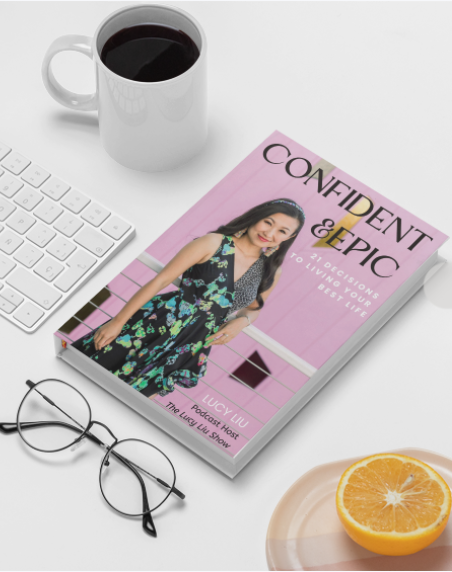
 Lucy Liu is a master life coach helping women uplevel in business and life to confidently live an epic life! She is an unshakable optimist, wife, mom, entrepreneur, workshop facilitator, motivational speaker, best selling author and podcast host of The Lucy Liu Show.
Entrepreneurs & high achievers hire her to see clarity and take quantum leaps FAST. Because most of them are overthinking, scattered and self-doubting. She's best at helping you get unstuck, make faster decisions and fulfill higher potential. Bottom line: not only make more money and impact, but have more fun and live an EPIC life by design.
She has been featured in Medium, VoyageLA, Elephant Journal, ThriveGlobal, South China Morning Post and dozens of other media outlets.
Lucy Liu is a master life coach helping women uplevel in business and life to confidently live an epic life! She is an unshakable optimist, wife, mom, entrepreneur, workshop facilitator, motivational speaker, best selling author and podcast host of The Lucy Liu Show.
Entrepreneurs & high achievers hire her to see clarity and take quantum leaps FAST. Because most of them are overthinking, scattered and self-doubting. She's best at helping you get unstuck, make faster decisions and fulfill higher potential. Bottom line: not only make more money and impact, but have more fun and live an EPIC life by design.
She has been featured in Medium, VoyageLA, Elephant Journal, ThriveGlobal, South China Morning Post and dozens of other media outlets.